
Pig War (1859) facts for kids
Quick facts for kids Pig War |
|||||||||
|---|---|---|---|---|---|---|---|---|---|
 — San Juan Islands — US — UK — Border proposed by the US — Border proposed by the UK — Compromise proposal — Modern border |
|||||||||
|
|||||||||
| Belligerents | |||||||||
|
|||||||||
| Commanders and leaders | |||||||||
| Strength | |||||||||
| 461 combatants, 14 cannons | 2,140 combatants; 5 warships mounting 70 cannons | ||||||||


The Pig War was an unusual confrontation in 1859 between the United States and Great Britain. It took place on the San Juan Islands, located between mainland Washington and Vancouver Island. The entire dispute began because of an unfortunate farm animal eating potatoes in a garden.
This confrontation is also known as the Pig and Potato War or the San Juan Boundary Dispute. Although both nations sent troops and warships, no human soldiers fought or died. The only casualty during the entire standoff was a single pig.
Contents
- Understanding the Roots of the Pig War Conflict
- The Potato Patch Incident of 1859
- Military Escalation on San Juan Island
- How Diplomacy Restored Order
- Twelve Years of Peaceful Coexistence
- The Final Resolution Through International Arbitration
- Historical Legacy and Modern Remembrance
- Images for kids
- See also
Understanding the Roots of the Pig War Conflict
How the 1846 Oregon Treaty Created Confusion
In the early nineteenth century, both the United States and Britain claimed the Pacific Northwest. To prevent a major war, the two nations signed the Oregon Treaty on June 15, 1846. This agreement set the international border along the 49th parallel.
The treaty stated that the border would follow the 49th parallel to the middle of the channel separating the mainland from Vancouver Island. From there, the line would run south through the middle of the channel to the Pacific Ocean.
However, the treaty writers did not realize that the local geography was complex. There was not just one water channel between the landmasses, but several different channels.
The Two Disputed Water Channels
Two main waterways separated the mainland from Vancouver Island:
- Haro Strait, located along the western side of the San Juan Islands.
- Rosario Strait, located along the eastern side of the islands.
The United States argued that the treaty meant Haro Strait. This route placed the San Juan Islands on the American side of the border.
Britain argued that the agreement meant Rosario Strait. This choice would place the San Juan Islands under British control. Both nations believed their own interpretation of the map was correct.
Why San Juan Island Was Valuable
San Juan Island held strategic military and economic value. Controlling the island allowed a nation to oversee the surrounding waterways.
The British Hudson's Bay Company established Belle Vue Sheep Farm on the island in 1853. They raised thousands of sheep and produced valuable wool.
At the same time, American settlers began moving to the island under United States land laws. By 1859, nearly thirty American farmers lived alongside the British ranch workers.
The Potato Patch Incident of 1859
The Runaway Pig in Lyman Cutlar's Garden
On June 15, 1859, an American farmer named Lyman Cutlar walked outside to check his vegetable patch. Cutlar had planted a garden of potatoes and other crops to sustain himself.
He discovered a large black pig rooting through his soil and eating his prized potatoes. Cutlar had chased the same animal out of his garden several times before.
Losing his temper, Cutlar grabbed his rifle and shot the pig, killing it instantly.
The Argument Over Fair Compensation
The dead pig belonged to Charles Griffin, an Irishman employed by the Hudson's Bay Company. Griffin managed the sheep farm and allowed his pigs to roam the island freely.
Cutlar felt remorse for his hasty action and went to Griffin to apologize. He offered Griffin ten dollars to pay for the lost animal.
Griffin refused the offer and angrily demanded one hundred dollars instead. Cutlar believed this sum was unfair and withdrew his offer entirely.
Cutlar argued that Griffin should have kept the pig inside an enclosure. Griffin replied that Cutlar should have built a better fence around his potatoes.
British Threats and Calls for American Help
British authorities visited Cutlar and threatened him with arrest under British law. Cutlar insisted that he was an American citizen on American soil.
The other American settlers grew worried that British officials would seize their farms. They gathered together and signed a petition asking the United States Army for military protection.
Military Escalation on San Juan Island
Captain George Pickett Arrives With Troops
Brigadier General William S. Harney, commander of the American Department of Oregon, received the settlers' request. Harney held strong anti-British views and acted without waiting for orders from Washington, D.C.
Harney dispatched Captain George Pickett and sixty-six soldiers from the 9th Infantry Regiment. They sailed aboard the warship USS Massachusetts and landed on the southern shore of San Juan Island on July 27, 1859.
Pickett issued a proclamation declaring the island American territory. He ordered his soldiers to set up camp near the British sheep farm.
When James Douglas, the governor of the Colony of Vancouver Island, learned of Pickett's landing, he reacted swiftly. Douglas viewed the American presence as an illegal invasion of British territory.
Douglas sent three Royal Navy warships under Captain Geoffrey Hornby to the island. Hornby carried orders to land British troops and remove the Americans.
Pickett refused to leave his position. He famously announced that his men would fight to the last person if attacked.
Fortifications and the Standoff

Realizing his original campsite was exposed to naval cannons, Pickett moved his camp north to higher ground. The soldiers began constructing an earthen fort known as Robert's Redoubt.
The defensive fortification was designed by Second Lieutenant Henry Martyn Robert. Robert later became famous for writing Robert's Rules of Order, a standard guide for conducting meetings.
Colonel Silas Casey arrived soon after with American reinforcements. By August 1859, the American force grew to 461 soldiers and fourteen cannons.
The British fleet expanded to five warships carrying over two thousand sailors and Royal Marines, armed with seventy heavy guns.
Cool Heads Prevent a Major War
Despite the tense standoff, both commanders acted with caution. Captain Hornby chose not to land British forces until senior officers arrived.
British Rear Admiral Robert Lambert Baynes soon arrived to take command of the fleet. Baynes inspected the situation and refused to open fire.
Baynes famously declared that starting a war between two great nations over a dispute about a pig was foolish. His wise decision kept the peace.
How Diplomacy Restored Order
President Buchanan Sends General Winfield Scott

News of the standoff took several weeks to reach Washington, D.C. and London. Leaders on both sides were shocked that local commanders had brought their countries to the edge of war.
President James Buchanan acted quickly to calm the crisis. He sent General-in-Chief Winfield Scott, the most respected officer in the U.S. military, to resolve the matter.
Scott had successfully settled past border disputes along the Canadian frontier. He traveled to the Pacific Northwest and opened talks with Governor Douglas in October 1859.
The Joint Military Occupation Agreement
General Scott and Governor Douglas agreed on a peaceful compromise. Both sides decided to share the island until their governments worked out a final boundary treaty.
The terms of the agreement included:
- Reducing troop numbers to a small peacekeeping force of no more than one hundred men per side.
- Establishing an American Camp on the south end of the island.
- Establishing an English Camp on the sheltered north end of the island.
- Allowing civilian settlers from both nations to live and work peacefully.
Pickett's main force departed, leaving a small guard behind. Royal Marines arrived to construct the British camp along Garrison Bay.
Twelve Years of Peaceful Coexistence
Daily Life in the Military Camps
For the next twelve years, British and American soldiers lived on opposite sides of the island. Instead of fighting, the troops formed friendly bonds.
Officers and soldiers visited each other regularly for dinners, celebrations, and sports events. They celebrated American Independence Day on July 4 and the British Queen's Birthday on May 24 together.
The soldiers organized horse races, shooting contests, and holiday feasts. Life on the island remained calm and orderly throughout the joint occupation.
How the American Civil War Affected the Dispute
During the 1860s, the United States fought the American Civil War. Many officers who served during the Pig War became prominent commanders during that conflict.
Captain George Pickett joined the Confederate States Army and led the famous charge at the Battle of Gettysburg. General Silas Casey served as a commander in the Union Army.
Because the United States was focused on the Civil War, negotiations over the San Juan boundary were put on hold for several years.
The Final Resolution Through International Arbitration
The 1871 Treaty of Washington
In 1871, the United States and the United Kingdom signed the Treaty of Washington. This comprehensive treaty settled several lingering disputes between the two countries.
Both nations agreed to place the San Juan boundary dispute before a neutral third party for arbitration (a formal process where an independent judge settles a disagreement).
They selected German Emperor Kaiser Wilhelm I to serve as the official arbitrator.
The Kaiser's Ruling
Kaiser Wilhelm I appointed an expert committee of three legal and geographic scholars in Geneva, Switzerland. The committee studied maps, historical records, and treaty documents for nearly a year.
On October 21, 1872, the arbitration panel delivered its final decision in favor of the United States.
The panel ruled that Haro Strait was the boundary intended by the original 1846 treaty. As a result, the entire San Juan Islands group became recognized American territory.
The Peaceful Departure of British Troops
The British accepted the ruling with dignity. On November 25, 1872, the Royal Marines lowered their flag, packed their equipment, and sailed away from English Camp.
The American garrison remained for a short time to maintain order before departing in July 1874. The dispute had ended without a single shot fired in combat.
Historical Legacy and Modern Remembrance
The San Juan Island National Historical Park
In 1966, the United States government created the San Juan Island National Historical Park to preserve the history of the standoff.
The park includes both the American Camp and the English Camp. Visitors can tour preserved barracks, visit Robert's Redoubt, and walk along the historic shoreline.
A Unique Symbol of International Friendship
Today, park rangers raise both the American flag and the British Union Jack over English Camp every day.
This daily ceremony makes the park one of the few places in the United States where federal rangers regularly fly the flag of another country. It stands as a lasting symbol of peaceful conflict resolution between neighboring nations.
Images for kids
-
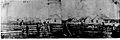
A photograph of Belle Vue Sheep Farm on San Juan Island
-
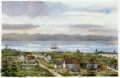
Watercolor of Belle Vue sheep farm at the time of the Pig War
-
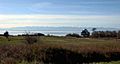
Modern view of the Belle Vue sheep farm site with the Olympic Mountains
-
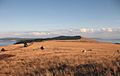
The redoubt had a commanding view of San Juan Island's southern tip
-
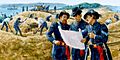
Watercolor of the US Army building Robert's Redoubt on San Juan Island
-
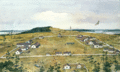
Watercolor of the American camp on San Juan Island
-
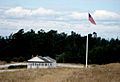
The American camp as it exists today
-
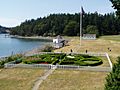
Union Jack flying at English Camp in San Juan Island National Historical Park
-
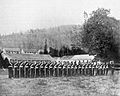
British troops peacefully evacuating San Juan Island in 1872


See also
 In Spanish: Guerra del Cerdo para niños
- Aroostook War – 1838–1839 border dispute between New Brunswick and Maine
- List of conflicts in the United States
- List of bloodless wars
- Military history of Canada
- Military history of the United Kingdom
- Military history of the United States
- Pastry War – 1838–1839 minor military conflict involving a looted bread shop
- Point Roberts
- The Great Rapprochement – Improving US–UK relations (1895–1915)
- War of the Stray Dog – Minor military conflict between Bulgaria and Greece in October 1925
- War of the Donkey – 13th-century war fought over the ownership of a donkey
